
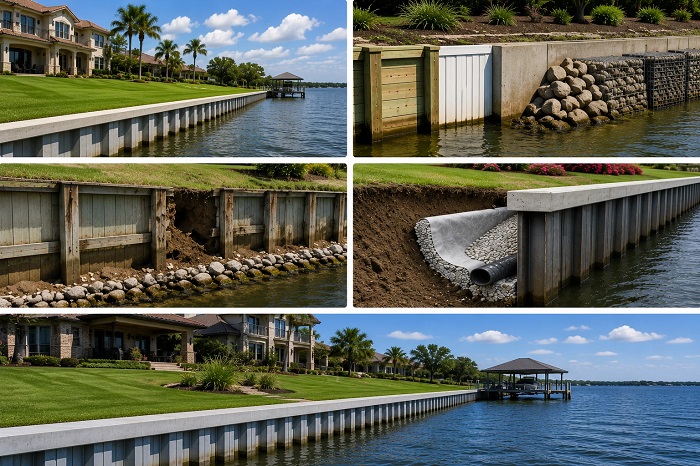
The material used for a seawall affects strength, maintenance, appearance, cost, and long-term performance. A wall that works well on a calm lake may not be strong enough for a shoreline exposed to storms, open water, or heavy wave action. That is why material selection should begin with the property conditions, not only with price.
Property owners comparing seawall materials can use custom seawall solutions as a reference point for common options such as wood, vinyl, concrete, stone, boulder, gabion systems, and repair work for existing structures.
A seawall must match the way water interacts with the land. Some shorelines need a rigid vertical barrier. Others benefit from stone systems that help absorb wave energy. Some properties need a low-maintenance modern finish, while others need maximum structural strength in a demanding coastal setting.
The right material also depends on how the property will be used. A private home, marina, yacht club, commercial waterfront, and industrial shoreline may all require different design priorities. Foot traffic, boat access, storm exposure, and future improvements should be considered before construction starts.
Wood seawalls for practical shoreline protection
Wood seawalls are a common option for waterfront properties where moderate wave activity is expected. They are often chosen because they provide a natural appearance and can be a cost-effective way to create a defined protective edge along the water.
Pressure-treated lumber is typically used because the structure must handle moisture and outdoor exposure. The performance of a wood seawall depends on material quality, pile spacing, fasteners, cap design, drainage, and the way the wall is connected to the land behind it.
Wood is not the best choice for every shoreline. If the property faces strong storms, heavy wave loads, or long-term exposure that demands greater durability, another material may be more suitable. However, for many residential waterfront areas, wood can be a practical and attractive solution when the site conditions are appropriate.
- Natural appearance — wood can blend well with residential landscapes, docks, decks, and traditional waterfront settings.
- Practical cost range — wood is often considered when the owner needs protection but wants to control the project budget.
- Good for moderate exposure — wood can perform well where wave activity is not extreme and the structure is properly built.
- Maintenance needs — wood should be inspected over time because moisture, fasteners, and soil pressure can affect its condition.
Vinyl seawalls for low-maintenance shorelines
Vinyl seawalls are often selected where the owner wants a clean look and lower maintenance than traditional wood. Vinyl does not rot like untreated lumber, and it can resist corrosion and UV exposure when the system is designed for the site.
Vinyl sheet piling can create a consistent wall face along the shoreline. This is useful for residential properties, community waterfronts, and commercial areas where a neat finished appearance matters. The material can be especially attractive when the owner wants a modern look without frequent surface maintenance.
Like any seawall material, vinyl must be supported correctly. Sheet piling, caps, walers, anchors, drainage, and backfill all affect performance. If the support system is weak, the wall can still move even if the panels themselves are durable.
Concrete seawalls for stronger wave conditions
Concrete seawalls are used when strength is the main priority. They can be appropriate for coastal areas, properties exposed to intense wave loads, and sites where a heavier protective wall is needed. Reinforced concrete can provide a strong monolithic system when it is properly engineered.
Concrete projects require careful planning because the material is heavy and the structure must handle pressure from both water and soil. Foundation design, reinforcement, forming, drainage, and curing conditions all matter. A poorly planned concrete wall can create expensive problems later.
For Gulf Coast properties or open-water sites, concrete may be considered when the owner needs a more robust seawall system. It can also work for commercial properties where long-term durability, strength, and structural consistency are more important than the lowest initial price.
- Review wave intensity — stronger wave action often requires heavier materials and a more reinforced design.
- Check soil conditions — soft or unstable soils can affect the depth and type of foundation needed for the wall.
- Consider maintenance expectations — some materials require more ongoing inspection and surface care than others.
- Plan drainage early — every material can be stressed by trapped water behind the wall if drainage is ignored.
- Match the design to property use — residential, marina, and commercial shorelines may need different wall heights, caps, and access details.
Stone, boulder, and gabion seawalls
Stone and boulder seawalls can be an excellent option where wave energy needs to be dissipated rather than simply blocked. Large natural boulders can create a strong, natural-looking shoreline edge while helping reduce the direct impact of water movement.
Stone systems require proper sizing and placement. Randomly dumping rock along the shore is not the same as building a seawall. The stone must be selected, layered, and placed so it remains stable under expected wave action. Base preparation and filter layers can be important for long-term performance.
Gabion seawalls use baskets filled with rock. They can provide flexible shoreline protection and allow natural drainage through the structure. This can be useful in some shoreline conditions, especially where controlled drainage is part of the solution.
Gabions must be designed carefully. The baskets, fill stone, connections, foundation, and edge transitions all affect performance. If the system is not installed correctly, baskets can deform, shift, or lose alignment over time.
How to compare seawall materials correctly
The best seawall material is not always the most expensive one. It is the material that fits the shoreline conditions, owner goals, budget, maintenance expectations, and future use of the property. A calm inland site and an exposed coastal property should not be treated the same way.
Cost is important, but it should be compared together with service life, repair needs, drainage requirements, and site access. Limited access can increase labor. Soft soil can change foundation needs. Greater wall height can require stronger reinforcement. These details can affect the full project more than the material alone.
Property owners should also think about how the seawall will connect to docks, piers, boardwalks, lawns, patios, and boat access areas. A wall that looks good but creates awkward transitions may reduce the practical value of the shoreline.
Choosing the right seawall material is a technical decision and a property-use decision at the same time. When the wall fits the site, it can protect the shoreline, improve appearance, reduce erosion problems, and support a better waterfront experience for years.