
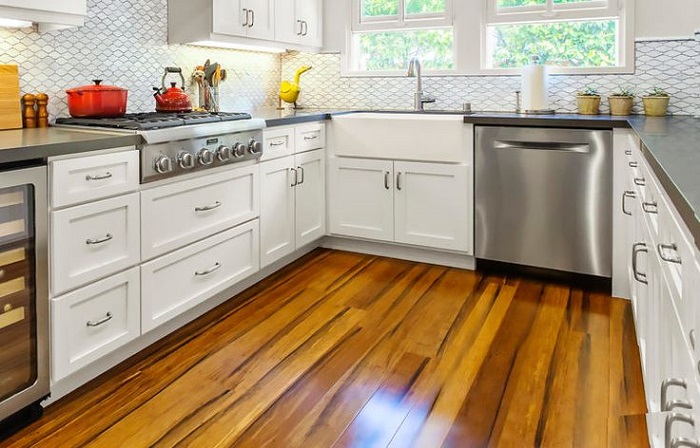
Kitchen floors are exposed to moisture, temperature fluctuations, dropped dishes, and constant foot traffic every day. Therefore, the finish should not only be beautiful but also practical: durable, non-slip, and easy to clean.
Before choosing a material, it’s important to consider your budget, interior style, and operating conditions: whether you have underfloor heating, how active your cooking is, and whether there are spills near the sink. These factors determine both the durability of the flooring and its ease of use.
Practical ideas and selection tips
1) Consider safety. For a busy kitchen, choose surfaces with reliable traction, especially if there are children or elderly people in the house. It’s best to avoid high-gloss surfaces in the wet area near the sink.
2) Consider zoning. You can separate the work area with tiles or porcelain tiles, and the dining area with a warmer material (vinyl or wood). The joint is finished with a threshold or a neat expansion joint.
3) Pay attention to the seams and grout. The fewer seams, the easier cleaning. For tiles, choose a stain-resistant grout, and make sure the color is practical.
4) Match the color and texture to your lifestyle. Dust and stains are more visible on floors that are too dark or too light. Medium tones and stone- or wood-effect textures work best, visually disguising small marks.
5) Check compatibility with underfloor heating. Tile and porcelain tiles are the most efficient in heat transfer, while vinyl and engineered wood require adherence to temperature restrictions.
6) Consider maintenance in advance. Kitchens benefit from finishes that can withstand frequent wet cleaning and household chemicals without losing their appearance; Check the manufacturer’s specifications and instructions for details, rather than relying solely on external details.
- For a family kitchen with active cooking: porcelain stoneware or high-quality quartz vinyl.
- For a kitchen-living room with an emphasis on comfort: engineered wood flooring (with careful use) or wood-look LVT.
- For a budget-conscious: moisture-resistant laminate with reinforced seam protection.
Bottom line: the ideal kitchen floor is a balance of moisture resistance, wear resistance, and ease of cleaning, complemented by a safe texture and a suitable design. Choose a material that suits your habits and pay attention to subfloor preparation – this directly affects the lifespan of the flooring.
Assess loads and usage scenarios: humidity, grease, dropped dishes
Kitchen floors are exposed to a combination of moisture, dirt, and impact loads every day, so it’s best to choose a flooring based on real-world scenarios rather than just a picture: how often people cook, wash, spill, move furniture, and whether there are children or pets.
Before purchasing, evaluate not only wear resistance but also safety: slip resistance in wet areas, resistance to household chemicals, and repairability in case of localized damage.
Key risks and what to consider
- Humidity and temperature fluctuations: low water absorption, sealed seams, and dimensional stability are important. Joints and abutments are especially critical in the sink and dishwasher area.
- Grease and stubborn stains: The coating must withstand frequent cleaning and degreasers; surfaces without deep textures and pores where dirt accumulates are preferred.
- Dropped dishes and impact loads: Consider resistance to chips/dents and the possibility of localized element replacement (tile, quartz vinyl/PVC tile) or repair (often easier with laminate/vinyl, more difficult with monolithic pours).
- Slip: For wet areas, choose more «sticky» textures; gloss and polished stone require special care.
- Seams and joints: The smaller and more sealed the seams, the easier cleaning and the lower the risk of moisture penetration; The weak point is the area adjacent to baseboards, thresholds, and under appliances.
- Identify the zones: «wet» near the sink, «greasy» near the stove, «passage» to the refrigerator/table.
- Make a list of traffic patterns: frequency of cleaning, likelihood of spills, presence of rugs, habit of drying dishes on the countertop/in the sink, movement of chairs.
- Check practicality: compatibility with underfloor heating, ease of stain removal, presence of a protective layer, the ability to replace 1-2 elements without dismantling the entire floor.
- Plan for protection: a rug near the sink, pads on furniture legs, neat thresholds/profiles, and high-quality sealing of the joints.
Bottom line: the best floor for the kitchen is one that easily withstands water, grease, and impacts, and does not become Slippery when wet and easy to repair. Evaluate the finish based on areas and actual usage – this will ensure the finish looks neat and lasts longer without unnecessary expense.