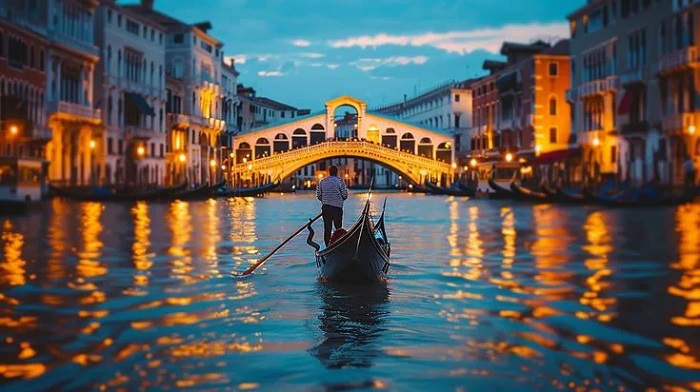
For centuries, Venice has occupied a strange position in the imagination of artists. The city appears constantly in paintings, literature, cinema and photography, yet each generation seems convinced it is seeing Venice for the first time. Perhaps that is because Venice resists becoming a finished image. It changes with weather, seasons, tides, restoration works, crowds, silence and light. The city exists somewhere between preservation and disappearance, between spectacle and everyday life.
Many places become symbols. Venice became something more complicated: an archive of human ambition, beauty, decay and reinvention.
Today millions visit Venice every year carrying cameras and smartphones, hoping to preserve a fragment of what they experience. Yet the paradox remains unchanged — Venice is one of the most photographed places on Earth and one of the most difficult cities to truly capture.
A City Built on Images Before Photography Existed
Long before photography appeared, Venice already understood visual identity.
The Republic of Venice spent centuries shaping its image through architecture, painting and ceremonial life. Wealth flowed through trade routes connecting Europe with distant regions, and art became both cultural expression and political language.
Painters transformed Venice into an idea as much as a place. The city learned early that imagery creates mythology.
Unlike many European capitals designed around power or administration, Venice developed around movement — ships, merchants, pilgrims, travelers. Constant exchange shaped its visual culture. Looking at Venice has always been part of experiencing Venice.
Even now visitors often arrive with expectations formed by films, paintings or postcards long before they encounter the city itself.
The Venice Biennale and the Reinvention of Contemporary Culture
Any discussion about Venice and modern creativity eventually reaches one institution: the Venice Biennale.
Founded in the late nineteenth century, the Biennale became one of the most influential cultural events in the world. Artists, architects, filmmakers and curators gather to present ideas that frequently extend far beyond traditional exhibitions.
What makes the Biennale unusual is not only the scale, but the dialogue between contemporary works and the city surrounding them.
Experimental installations appear inside historical spaces.
Questions about technology are discussed in buildings older than many nations.
Ideas about the future coexist with walls carrying centuries of memory.
Venice becomes less a backdrop and more an active participant.
This tension partly explains why creators continue returning. The city encourages comparison between permanence and change.
Why Artists Rarely Experience Venice Like Tourists
Tourists often measure cities through landmarks. Artists tend to notice repetitions.
A particular reflection appearing at the same canal every autumn.
The texture of aging walls after rain.
Shadows changing during winter afternoons.
The silence of certain districts before sunrise.
These details rarely become famous, yet they often shape creative work more than monuments do.
For photographers, painters and filmmakers, Venice is not simply beautiful. Beauty alone becomes predictable. What continues attracting creators is complexity.
Venice contains contradictions:
Luxury and deterioration.
Mass tourism and isolation.
Performance and authenticity.
The city constantly negotiates between preserving itself and adapting to new realities.
Creative people are usually drawn toward places where contradictions remain unresolved.
The Relationship Between Photography and Memory
Photography changed humanity’s relationship with travel.
For earlier generations, journeys often survived only through written descriptions or paintings. Photography promised something different: preservation.
Yet photographs never preserve places completely.
They preserve interpretation.
A frame excludes more than it includes.
Light changes meaning.
Perspective alters emotion.
Two people standing in the same location may produce entirely different visual memories.
This becomes especially visible in Venice because expectations surrounding the city are so strong.
Visitors frequently attempt to reproduce existing images rather than discover personal experiences.
The result is familiar: thousands of nearly identical photographs.
The challenge begins when creators move beyond documentation.
When Travel Photography Becomes Personal Narrative
During recent years, interest in individual visual storytelling has grown significantly.
People increasingly seek photographs reflecting atmosphere rather than proof of presence.
The difference seems subtle but changes everything.
A documentary image asks:
«What does this place look like?»
A personal image asks:
«What did this place feel like?»
That distinction explains the growing attention toward photographers working with atmosphere and human presence rather than only landmarks.
Among independent creators based in Italy, Antonio Jarosso explores portraiture and visual narratives connected with Italian cities, focusing on emotional context as much as location itself.
In this approach, cities become part of stories rather than decorative backgrounds.
Venice as a Space Between Reality and Performance
Venice understands performance unusually well.
The city has lived through centuries of ceremonies, masks, carnivals and theatrical traditions.
Even ordinary movement through Venice occasionally resembles choreography.
People arrive searching for certain emotions.
The city responds.
Some leave disappointed because reality failed to match expectations.
Others become fascinated precisely because Venice feels impossible to define.
The same ambiguity attracts filmmakers.
Countless productions have used Venice not simply as scenery but as psychological space.
The city often represents mystery, nostalgia, desire or disappearance.
These interpretations continue evolving.
Can Photographs Become Collectible Art?
For much of photography’s history, debate continued around one question:
Should photographs be considered documents or artworks?
Today the distinction appears increasingly irrelevant.
Collectors purchase photographic prints.
Galleries dedicate exhibitions entirely to photography.
Large-scale works enter private interiors alongside paintings.
Meanwhile commercial techniques influence artistic production, and artistic approaches shape advertising imagery.
Boundaries become fluid.
This transformation changed expectations toward photographers as well.
Many creators move between commissioned work, editorial projects and independent artistic production without strict separation.
The boundary between applied photography and collectible visual work has become increasingly blurred, with many authors presenting contemporary photographic works alongside commercial projects.
The evolution reflects broader cultural shifts.
Images no longer serve only practical purposes.
They also function as objects carrying atmosphere, memory and identity.
Why Certain Cities Produce More Visual Culture Than Others
Not every city generates lasting artistic fascination.
Infrastructure matters less than density of experiences.
Cities inspiring creators usually possess several qualities:
Visible history.
Contradictions.
Strong local identity.
Changing light.
Layers accumulated over centuries.
Venice contains all these elements simultaneously.
Perhaps excessively.
That abundance sometimes overwhelms visitors.
But for creators willing to observe patiently, the city offers almost endless material.
Beyond Famous Landmarks
The future of visual culture connected with Venice may depend less on iconic locations and more on overlooked spaces.
Small workshops.
Quiet residential districts.
Industrial fragments.
Morning deliveries.
Ordinary routines.
As overtourism reshapes historical centers worldwide, attention increasingly shifts toward authenticity.
People become tired of universally repeated images.
Interest moves toward nuance.
The most enduring photographs often emerge from places initially appearing insignificant.
The Responsibility of Preserving Atmosphere
Modern technology made image production effortless.
Billions of photographs appear every year.
Paradoxically, abundance increases the value of images carrying intention.
Not every photograph deserves permanence.
Not every moment requires documentation.
But thoughtful images occasionally preserve something difficult to articulate — a particular emotional state, a version of a city existing briefly before disappearing.
Venice has experienced repeated predictions of decline throughout history.
Floods.
Economic changes.
Political transformations.
Mass tourism.
Environmental concerns.
Yet the city persists.
Not unchanged, but alive.
Perhaps this resilience explains why Venice continues attracting creators despite endless reinterpretation.
Every generation believes it discovered something new.
In reality, the city simply reveals different layers depending on who is looking.
The City and the Person Looking at It
Ultimately, places do not exist independently from perception.
Two individuals may walk through identical streets and remember entirely different cities.
Art begins somewhere inside this gap.
Between location and interpretation.
Between observation and meaning.
Between memory and image.
Venice remains one of the rare places where these boundaries feel unusually visible.
That may be why painters, filmmakers, writers and photographers continue returning.
Not because the city has already been fully understood.
But because it probably never will be.