
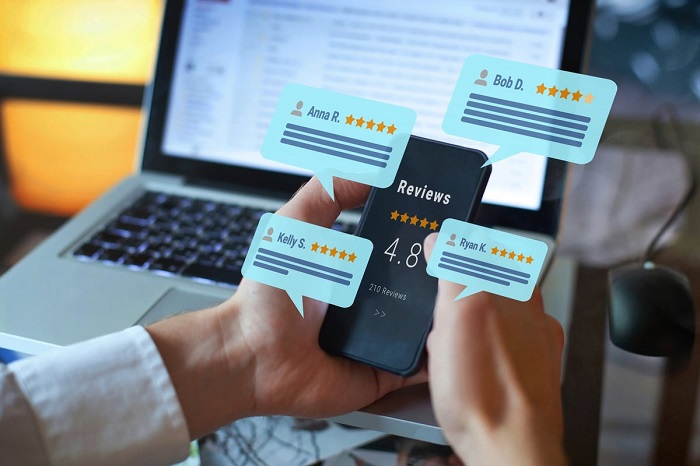
In 2026, reviews influence 32% of purchases — more than discounts and coupons do (Source: SocialPilot, 2026). Think about that: a slice of rating that costs the business nothing directly outweighs the very tool companies cut their margins for. And it isn’t a one-off number — all of this year’s data points the same way.
Reviews have stopped being a “nice-to-have” next to the product card. Across various measurements, between 92% and 99% of shoppers read reviews before buying (Sources: BrightLocal 2026; Capital One Shopping, 2026). The review has become a mandatory link in the funnel — the spot where a buyer decides whether to trust you or walk away. This article is about what reviews actually do to sales, and how to manage it.
A Review Is Part of the Funnel, Not an Afterthought
To gauge the impact, start with buyer behavior. 93% of consumers say online reviews influence their purchase decisions (Source: Amra & Elma, 2025). Reviews are read across every age group: 97% among 18–34, 93% among 35–54, and 82% among 55+ (Source: BrightLocal / Podium, 2026). The channel doesn’t work on a “young audience” — it works on everyone.
The key shift is in the level of trust. 49% of consumers trust online reviews as much as personal recommendations from friends and family (Source: BrightLocal, 2026). BrightLocal has tracked this figure for more than 15 years, and it stays high despite rising skepticism. In effect, a stranger’s review works like a friend’s recommendation — but it scales to thousands of buyers at once.
Note: Reviews shape perception before the buyer ever reaches the price. If trust isn’t built at that stage, a discount won’t save it — the person simply leaves for a competitor who has reviews.
What Reviews Do to Conversion: Numbers, Not Hunches
Here the impact is measurable to the percentage point. Research from the Spiegel Research Center shows that products with even 1–10 reviews convert 52.2% better than products with no reviews at all — the barrier to entry is very low (Source: Spiegel Research Center). And from there, the effect only compounds.
| Factor | Impact on sales/conversion | Source |
|---|---|---|
| Having 5+ reviews on a product page | +270% to purchase likelihood | Trustpulse / Bazaarvoice, 2026 |
| Reviews on higher-priced items | up to +380% to conversion | Spiegel Research, 2026 |
| Displaying reviews on the site | +19.8% to sales | Capital One Shopping, 2026 |
| Reviews from verified buyers | +15% to conversion | Capital One Shopping, 2026 |
| Each additional star of rating | +5–9% to revenue | Harvard Business Review |
| Active review management | +18% to revenue growth | Womply, 2026 |
The main takeaway from the table: reviews don’t work linearly. The first few remove uncertainty at the moment of decision, volume adds trust, and active review management turns them into a steady revenue driver rather than a one-time effect.
The Magic of Stars: Why 4.5 Sells Better Than 5.0
A counterintuitive fact almost everyone misses: a perfect rating hurts. Conversion peaks in the 4.2–4.5 star range, not at 5.0 — a flawless score reads to the buyer as “too good to be true” (Source: Spiegel Research / PowerReviews, 2026). A little imperfection makes reviews human, and therefore believable.
Behavior in search results confirms it. Click-through rate (CTR) by star rating breaks down like this:
| Rating | CTR | Note |
|---|---|---|
| 5.0 stars | 39% | Raises suspicion of manipulation |
| 4.5 stars | 47% | Trust sweet spot |
| 4.0 stars | 44% | Solid |
| 3.5 stars | 27% | Sharp drop in trust |
(Source: Searchlab, 2026)
The thresholds are hard: 57% of buyers will only use businesses rated 4 stars or higher, and 87% won’t even consider a company rated below 3 (Source: DataPins, 2025). Dropping from 4.5 to 3.5 isn’t “a little worse” — it’s a cliff.
Pro Tip: Don’t chase a perfect “five” and don’t delete every negative review. A couple of critical but politely handled reviews alongside a mass of positive ones builds more trust than a sterile wall of five stars.
Trustpilot as a Special Case
Among platforms, Trustpilot holds a special place for service and online-first brands. It has accumulated more than 310 million reviews of companies worldwide and grows roughly 28% a year — in a single year users left over 61 million new reviews (Source: Trustpilot Annual Report, 2026). Its star-based TrustScore has become a recognizable reputation signal that lets a buyer decide in seconds whether you can be trusted.
Trustpilot’s value is twofold: it builds trust on the platform itself and strengthens the brand’s presence in search — company pages and star snippets surface in Google for branded and commercial queries. For a new brand, an empty or weak Trustpilot profile is a missed conversion at the exact moment a buyer is checking you out before paying.
Social Proof and How to Grow Your Review Volume
The mechanics of social proof are simple: the more reviews and the higher the rating, the more trust — and the more willing the buyer is to leave a review too. A “snowball effect” kicks in, where highly rated products pull in even more reviews (Source: Yotpo). The problem is that organic volume accumulates slowly, while the buyer makes a decision today.
So brands use different ways to speed up filling a profile: automated review requests after purchase, email sequences, QR codes on packaging, and some turn to direct acceleration through services like buy trustpilot reviews to clear the threshold faster, after which a profile looks alive and organic flow takes over. The approach is aggressive and carries risks (more below), but the logic is the same as throughout this article: the first reviews remove uncertainty, and an empty profile converts nothing at all.
Warning: Any artificial or improperly collected reviews violate platform rules and are actively purged. Trustpilot removed 4.5 million fake reviews in 2024 and 7.8 million in 2025 (Source: Trustpilot / SocialPilot). Betting on manipulation alone is a game against the platform, and you can’t build an entire channel on it.
The Flip Side: A Trust Crisis and Fakes
An honest conversation about reviews in 2026 has to include the worrying trend. Overall trust in online reviews fell to 62% — down 6 percentage points in a year — because of “fake-review fatigue” (Source: 4,200-respondent survey, 2026). At the same time, 42% of buyers are directly worried about fake reviews, and by some estimates up to 30% of all reviews online may be fake (Sources: Gitnux; Fakespot).
But here’s what matters: trust didn’t fall evenly. Buyers didn’t stop believing reviews — they got smarter. Specific signals held steady and even gained weight:
- Verified purchases. The “verified buyer” badge has become a decisive credibility filter.
- Recency. 73% of consumers don’t trust reviews older than a month, and 83–85% consider reviews older than three months irrelevant (Sources: Ringly, 2026; DataPins). An old stream of reviews loses its value.
- Brand responses. A company reply to reviews raises trust; responding to even 25% of reviews lifts revenue by about 35% (Source: Ringly, 2026).
- Realism. Reviews with photos, details, and a moderate rating convince more than sterile positivity.
Note: In 2026, the winner isn’t the one with the most reviews — it’s the one whose reviews look authentic: verified, fresh, and answered by the brand. Credibility has become a currency of its own.
How to Build a Review System: The Practical Minimum
Review management is a process, not a one-off task. The minimum working system:
- Ask for reviews systematically. 89% of buyers are willing to leave a review after a positive experience if asked (Source: BrightLocal, 2026). Automate the request after a purchase or a completed service.
- Keep the flow fresh. Because recency matters, reviews need to be collected continuously, not in one campaign a year.
- Respond — especially to negatives. A reply turns criticism into proof of an attentive brand and directly affects revenue.
- Collect verified reviews. Prioritize confirmed purchases: they earn more trust and are more resistant to skepticism.
- Don’t polish the rating up to 5.0. The target range is 4.2–4.7. A realistic picture converts better than a perfect one.
Frequently Asked Questions
How much do reviews really affect sales?
A lot, and measurably. Reviews influence 32% of purchases (more than discounts), having 5+ reviews lifts purchase likelihood by up to 270%, and active review management adds about 18% to revenue growth.
Do people trust online reviews in 2026?
Broadly yes, though trust slipped to 62% because of fakes. At the same time, 49% trust reviews as much as personal recommendations — trust has shifted toward verified, fresh reviews with brand responses.
Which rating converts best?
Not 5.0, but the 4.2–4.5 star range. A perfect score reads as suspicious, and the CTR sweet spot in search lands at 4.5 stars (47% CTR).
How many reviews does a business need?
The effect starts with just 1–10 reviews (+52% to conversion), but the audience’s trust threshold is 4 stars and a visible volume. Maintaining a steady flow of fresh reviews matters more than hitting a one-time count.
What matters more — quantity or recency?
In 2026, recency has moved to the front. Up to 73% don’t trust reviews older than a month, so a steady stream of new reviews is worth more than a large but aging archive.
Reviews Aren’t Reputation “for Later” — They’re Sales Today
Online reviews in 2026 have stopped being part of image and become part of the till. They sway decisions more often than discounts, lift conversion several times over, and build trust at the exact point where a buyer is choosing between you and a competitor. At the same time, the market has matured: an empty profile converts nothing, a perfect rating raises suspicion, and old or unverified reviews lose their weight.
The practical conclusion: you don’t just need to “have” reviews — you need to collect, refresh, and work them systematically, as a sales channel in its own right. If your brand’s profile is sitting empty or caked in old reviews, the most profitable investment right now is to start a steady stream of fresh, authentic ones. Those are what sell while you sleep.